
History
St Dilpe and the Celtic Foundation of Landulph Church
Tracing the origins of our church and parish takes us on a journey through fifteen centuries of history.
Landulph Church is dedicated to two saints: St Leonard and St Dilpe. St Dilpe is of Celtic origin and gives his or her name to our parish: Lan–Dulph, meaning the sacred enclosure of Dilpe. But who was St Dilpe?
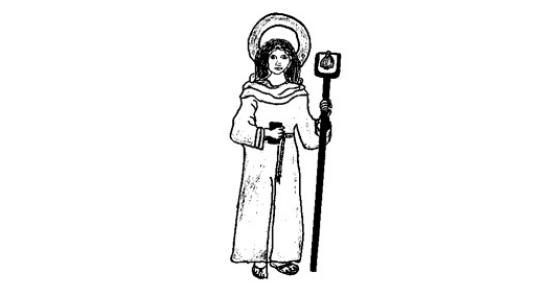
Over the centuries, the name of our Celtic patron has been altered from its original form and recorded variously as Dilit, Dilic, Dylytt, and Delech. All of these provide a possible link to St Dilic, a female Christian missionary of the 5th or 6th century AD.
St Dilic is believed to have been one of the many children of Brychan, the legendary Welsh king of Powys, who gave his name to Breconshire. Brychan’s twenty four children are said to have landed on the north coast of Cornwall and spread Christianity throughout the Southwest of England.
In addition to her association with Landulph, there was once a St Dilic’s Chapel in St Endellion parish, and a place called St Dellec in Brittany.
The Celtic saints often travelled by water in lightly built coracles, and this was likely the form of transport used by St Dilic as she navigated the waters of the Tamar estuary in search of a place to settle. She found such a site where our present church now stands. (Before the construction of the dyke in 1810, the Tamar reached the churchyard wall at high tide.)
Today’s churchyard boundary reflects the outline of the original Lan—the sacred enclosure—formed by creating a loop of earthen bank drawn inward from a low cliff that once formed part of the foreshore. Some such enclosures were monastic in origin, while many others were simply burial grounds containing a small oratory, a nearby well suitable for baptism, and either a wooden or stone cross.
To dedicate the church for the preaching of the Gospel and the celebration of the Eucharist, the local saint would traditionally spend forty days in prayer and fasting.
It was once common for local girls to be named after their patron saint, and this custom was still in practice a thousand years after the life of Dilic. In the 16th century, for example, Delicta Moone and Delicta Freethy were baptised at Landulph.
By the Middle Ages it had become fashionable to rededicate churches to more widely recognised saints, and by 1346 St Leonard had become joint patron. Both saints were once depicted in painted murals at the east end of the church, but these were sadly defaced during the Reformation of the 16th century.
© Andrew Barrett, January 2026, All rights reserved
This article is protected by copyright - please contact editor@landulph.org.uk if you want to use it.
