Arts
Our Bus-Shelter Murals
King Charles 111 was crowned on 6th May, 2023,
and towns and parishes up and down the country set about finding ways to commemorate
it. Landulph Parish Council came up with
an excellent way to celebrate the event: here we had a recently-refurbished bus
shelter, a sturdy building with five white walls, giving us five pristine
canvases saying ‘Paint me!’ Artists living locally were invited to submit
relevant ideas. Mine were based on
landscapes and activities illustrating the area and were accepted by the Parish
Council.
I had some experience of large-scale compositions, but that was theatre scenery, years ago and indoors. I began researching such things as good
paints and how to treat the walls before and after painting, then set myself
the enjoyable task of choosing the scenes for each wall. Regrettably, with only five walls (the sixth
is the outside back and is part of a hedge) and many beautiful aspects to
the parish, this was a rather more difficult task: so many scenes would perforce be left out.
The whole process seemed slow, but with technical complications to deal with, to rush it would inevitably bear consequences later. However, before the Summer of `23 came to an end, I managed to scrub the walls, measure them in detail, wonky bits and all, and apply two coats of stabiliser. This is when I met the residents: spiders rappelling at speed from the rafters to hang accusingly at eye-level, and snails waiting in front of my brush-line to be rescued, only to return by next morning. The last step before winter was to finalise the guide-sketches and mark up a grid. This grid, drawn to scale on the walls to match your sketches, enables the painter to transfer the design accurately.
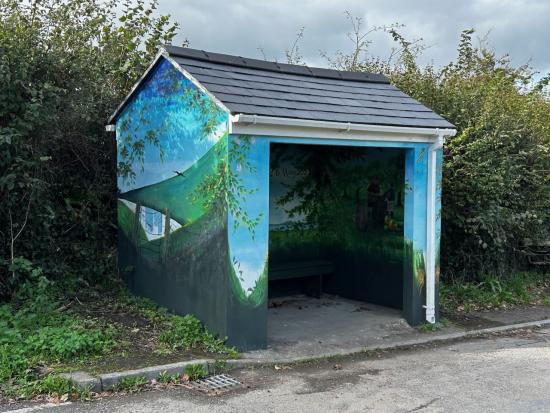
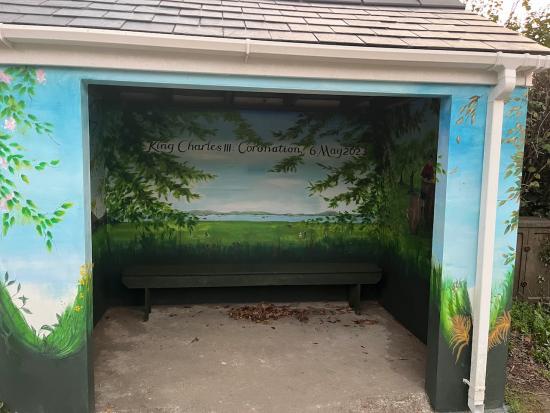
It was when outside work began again that a few obstacles sneaked in to obstruct progress. The design for the back inside wall, the biggest, had to be scrapped and started again from scratch, to accommodate the prescribed legend: ‘King Charles 111 Coronation; 6th May 2023’. This was originally intended to be written over the entrance, but that space, already restrictively narrow, was found to consist of a shiny plastic; paint could be applied but would soon peel off. Sadly, the words didn’t fit well into the intended back wall design and would need to be incorporated into an entirely new composition. Nothing to be done but heave a sigh, consign the first sketch to the bin and sit back down to the drawing-board.
Early on, the water-resistant paint I was using turned out to be not resistant enough, after a very heavy series of showers washed most of the cider-makers off. I sent off for guaranteed 100% waterproof paints by overnight delivery. These paints are tough but the colours are not subtle. I decided to accept that challenge, determined to achieve subtlety whatever it took.
The
next problem was one that could not be overcome and would affect every square
millimetre. The surface of the walls was
entirely made up of thousands of sharp little points and pits. Without re-surfacing the whole building, which
is what I discovered some mural-painters insist on at huge expense, I had to
adapt the whole project to suit this hostile surface. Small details and straight lines might be
impossible. My overall aim had, from the outset, been to create
pictures meaningful from a distance but also interesting close-up. My treasured plan for hidden
scenes-within-a-scene, such as animals and birds only just discernible within
the foliage, would have to go. Unwilling to give up now or adopt the
simplistic style of other murals, I accepted the restrictions imposed by the
surface with the motto: ‘There’s always a way’.
Further
delays were what people usually call ‘Life getting in the Way’ and it began to
seem as if I’d never work again.
Nevertheless, by Spring 2025, the
base area was painted all round the building inside and out. For this, I chose the toughest exterior
masonry paint in the darkest possible green, to avoid showing the dirt - mainly
bouncing up from the ground when it rains - and scuffs from shoes, and
incorporated it into the designs. It
worked like a dream, blending well where necessary with the acrylic that was
used for most of the rest of the work. The same is
true of the white, used to dilute the colours, and of another supposed dark
green, chosen from a colour-chart and wrong. (Once mixed, the paint-store won’t take it back. Never trust a paint-chart was their advice!) Luckily it turned out to be a grey-green, again
useful for blending. In my view, the constant search for blends and half-tones was worth the struggle: these murals would be right in
the centre of the Parish and everything had to be right; ‘basic’ colours would not be good enough.
The murals are
designed to represent the seasons, with Winter and early Spring on the inside
and outside short walls to the left as you look in. Here there’s a view of the river reminiscent
of that from the back of the Memorial Hall.
The trees are bare, the people walking their dogs are blown about in the wind
and there’s a tractor on a ploughed hillside.
Towards the corner where the inside wall joins the long wall, pale green
leaves appear, along with blossom, indicating the start of Spring. As we look along the back wall, we’re
seeing later Spring and Summer, with a sunny meadow; people strolling, children
playing and boats on the Tamar. Initially planned to be glimpsed through a deep wood, as soon as I stood
inside the shelter, while at the same time assessing how the sketch would look on the final large scale, I realised that the painting would be too gloomy. Back to the drawing-board
again, to make more changes. Now, after a few changes, there’s
no loss of foliage, but what you see is more of the broad green Summer space
and the River, as if you were looking out from the edge of the wood,
rather than peering through tangled trees and undergrowth. Autumn follows to the right, on the inside
with cider-makers and outside with a view of Kingsmill Lake and the bridges at Saltash, arranged not only to fit the space, but to create a scene I'd like to see. I’ve adapted the
scenery that actually exists, leaving out out Ernesettle and St. Budeaux, historic though they be, and also most of Saltash. Now there's a wide
horizon as if once under the bridges, you’re out at sea. None of these walls bears a photographic representation, because a photo could do that, but a reference intended to provoke curiosity and invite speculation.
Somebody mentioned that mural-painters traditionally sneak in an image of themselves. So I’m there on one of the walls that include a stretch of water, not really recognisable, as a tiny figure rowing a single scull.
The very last process was to coat all the murals with several layers (to ensure it gets
into all those afore-mentioned pits) of a product which is water-,
mildew-, and graffiti-proof, and UV-resistant.
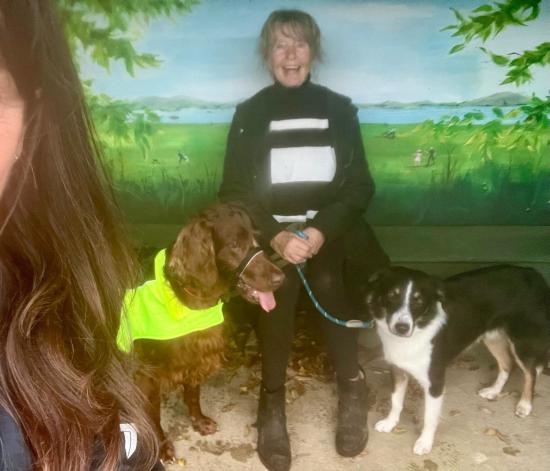
I expected painting these murals to be an enjoyable process and wasn't disappointed, despite the obstacles and the length of time it all took. It’s liberating to paint large-scale, with long sweeps of the brush, and it’s gratifying to stand back at the end of a long day and assess whether your concept is developing as you intend and assuming a substantial presence. But what meant most by far was the reaction of passers-by; people who diverted from their usual walk to see how things were progressing, some drove the long way round and called out banter. I've met lots of people I only ever waved to before. I enjoyed the proffered advice, welcomed the hot chocolate (very special),and looked forward to fielding excited comments and questions from the school-children: 'when are you going to put the tractor in? Why are there seagulls round it? Is that bird a wren?'
Far too many treasured comments to list here, but all to be remembered forever.
© Gill Mannings Cox, November 2025, All rights reserved
This article is protected by copyright - please contact editor@landulph.org.uk if you want to use it.