

Future
Climate Crisis
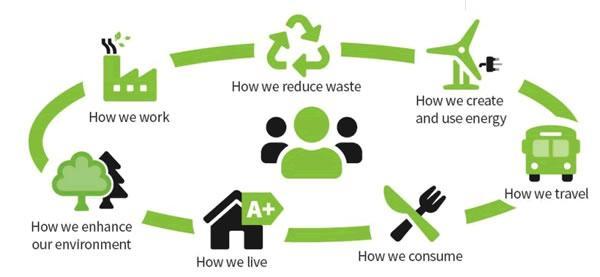
To become carbon- neutral we need to reduce the amount of carbon dioxide we produce and capture the carbon dioxide we do produce to prevent it entering the atmosphere. In this way our impact on the planet will support a positive future for everyone. To achieve this target, businesses, residents and organisations in Cornwall need to work in partnership with Cornwall Council to tackle carbon emissions in the areas illustrated in the diagram above.
Although this is a huge national issue - there is something everyone can do - from the way we work, the way we travel, the way we purchase things, the way we dispose of things, the way we keep warm ... and even what we eat. This is something that everyone can make a difference with - lots of small initiatives can have a big effect!
Using a Thermal Camera
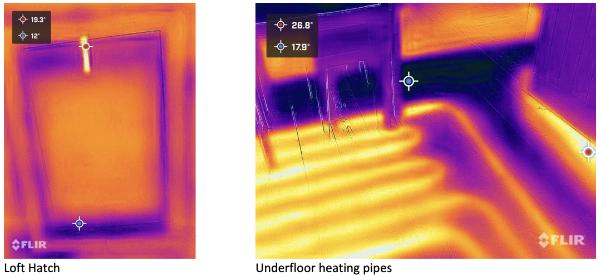
Landulph Parish Council has recently purchased a FLIR One Pro thermal camera for Landulph Climate Group (LCG) to use. This thermal camera combines an ordinary digital picture with an infrared picture so that you can see temperature differences represented by colour shading combined with an outline of the background. Thermal cameras have many uses but LCG will be using it to help residents in our local community identify cold spots in their homes. Once identified, simple insulation (eg draught excluders or extra loft insulation) targeted at these cold spots can keep your home warmer and save on heating costs.
Loft hatches and exterior doors are common sources of cold air. The pictures above were taken with LCG's thermal camera. The colour ranges from blue (cold) to yellow (warm). The temperature of the coldest point around the loft hatch is shown (12 degrees centigrade) and the warmest point (19.3 degrees centigrade). The warmest point is actually the metal catch that holds up the loft hatch and shows hotter because shiny surfaces radiate more heat. Another use of thermal cameras is to identify where hot or cold water pipes run.
If you would like members of LCG to come and take thermal photographs of some aspect of your house for you, please contact lcg@landulphparishcouncil.gov.uk to arrange a visit. Please note, members of LCG are not experts in thermal imaging and cannot provide advice on the interpretation of these images.
Landulph Summer Bioblitz
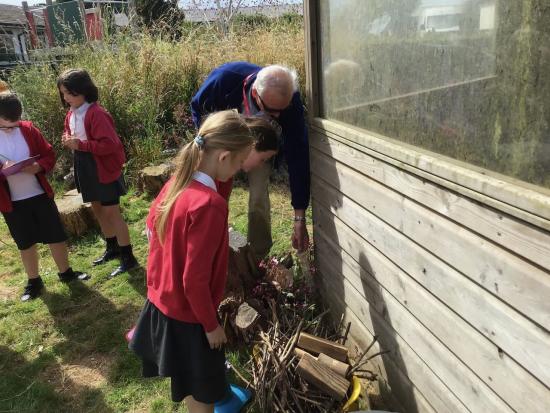
In summer 2024 we ran a BioBlitz in Landulph with the opportunity to win a prize. We have already had great fun trialling the BioBlitz at Landulph School on 4 July, and now we'd like anyone who lives or visits Landulph to take part: old or young, on your own or with friends or family.
Species identification website: Cornwall Wildlife Trust
Species identification website: Buglife
Waiting for the bus

Reuse, Recycle, Reduce
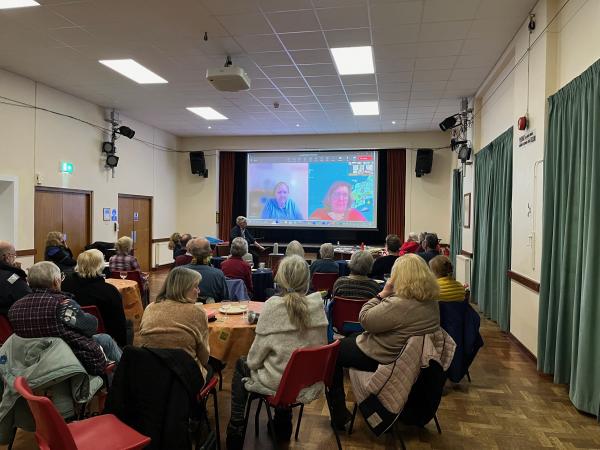
The Climate Matters talk on 5 February 2024 focussed on waste as Landulph's waste collection changed in April 2024.
Our guest speakers included Councillor Carol Mould from Cornwall Council - Portfolio holder for Neighbourhoods including waste collection, disposal and minimisation. Councillor Mould explained the changes, including the new fortnightly rubbish collections, to help us waste less and recycle more.
With reusing in mind, we were also pleased to welcome Rosie Waters from Saltash Scrapstore. Rosie started the Scrapstore five years ago with the aim of minimising the amount that goes to landfill. Rosie explained Scrapstore’s success by showing how items that some would consider scrap are of use to others and what the Scrapstore has to offer.
Cornwall Council: Food Waste, Recycling and Rubbish Collections (pdf)
Climate Crisis
Energy
Nature
- Landulph Summer Bioblitz
- All Aflutter over Butterflies and Beavers?
- Nature Recovery in Landulph's Changing Climate
- Eco Day at Landulph School
- Biodiversity
- The Benefits of Trees
Transport
- Waiting for the bus
- Transport for All
- Is it a bus - no, it's a research tool
- Public Transport Competition
- Summer Days Out