People
The Honeys and "Juliet"
We both started our sailing in dinghies, and when we met 64 years ago. Glenn had a background of GP 14 sailing, being a founder member of the Frensham Ponds S.C. where he raced. I sailed Enterprise dinghies with a group of friends who had three boats that we owned as a co-operative club.
In the early days of our marriage, we were poor of time and money, modernising a Victorian cottage (gas lights and no inside lavatory!), and then buying a small house on neglected farm land, and building, extending and reclaiming while enjoying two small children.
As we got on top of all that, we bought a Wayfarer dinghy that we used for family outings and picnics but soon started racing in a very competitive fleet in Chichester harbour.
We towed the Wayfarer down to Cornwall for a summer holiday in Rock where we bumped into a business partner of Glenn’s who had just bought a Cornish Crabber and asked us to come and join the launch celebration. Glenn was very enamoured of it and booked with the building yard to be taken out on a trial sail. I told him off for wasting the salesman’s time and he said that he really wanted to buy one, to which I responded that it was very different from dinghy sailing and that neither of us had done any cruising in a small boat and I might really hate it and be sea sick and. Glenn promised that if I hated it, he would sell it after one season, and he is always true to his word. He was very lucky as I loved it, although occasionally seasick.
The Crabber was very pretty with her tan sails, and playing with the sail opportunities of a gaff rigged cutter was fun. She had a lovely cockpit but was very cramped below, with only sitting headroom. The children were getting bigger (one of them seasick) and I was tired of cooking on a frightening two burner paraffin stove while twisted sideways sitting on the berth!! After two seasons we sold her and looked for a more serious and comfortable cruiser.
We decided that the Vancouver 32 was top of our wish list but a new one was beyond our budget. Here we were very lucky as there was one for sale just over a year old and hardly sailed. The owner had more money than sailing experience, had no confidence without an experienced crew with him, and when his wife complained that she was not interested and wanted him to sell so she would have a new kitchen – we were there as keen buyers at the right time!
Then we just used all our spare time and holidays to use her in all conditions, and in the winter went to night classes to get our RYA cruising credentials. What a great training scheme it is! We cruised extensively across the channel in Holland, Belgium, France and North Spain, as well as all the south coast of England as far as the Isles of Scilly.
In 1991 we brought our beloved “Juliet” to her Cargreen mooring and with our retirement we start extending our cruising.
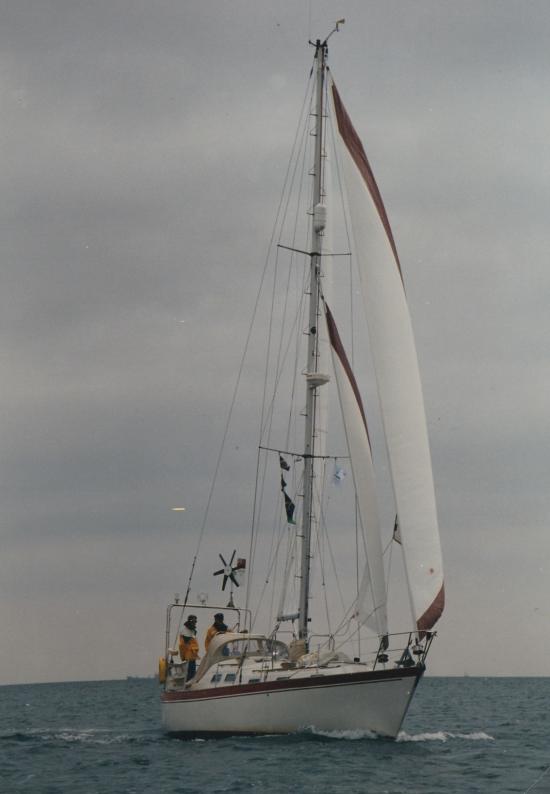
Cargreen Yacht Club would become an important part of our sailing life and I need to say a bit about the acquisition of the present club site. When we arrived in the village their premises were a rather dilapidated caravan on the Spaniards Quay, but we very soon learnt that the Club membership was an extraordinary group of adventurers. I well remember our first social gathering which was an annual dinner held in the Spaniards Inn. I sat down next to a homely grey-haired lady and expected the conversation to soon be the weather, her garden or her grandchildren. Gosh how wrong I was! They had done two Atlantic crossings and we talked about the contrasting merits of doing it in a mono or a multi hull.
At around this time the wonderful Club Treasurer, and village benefactor, Jim Clouting, together with the Club secretary Peter Patterson managed to purchase the present site for the Club and the caravan was moved there. Jim subsequently also applied for a grant from the very new Sports Lottery and the club received a large award sufficient to build the Club house and car park. We were the first sailing club to get an award from the Sports Lottery. Glenn joined the committee and used his experience of planning matters to assist in the fight with the District Council planners who were asking for a low stone building in keeping with “the vernacular of the local riverside”. With others we toured up and down the Tamar trying to find wooden buildings that would change their minds and Glenn, with other club members, lobbied all the planning committee personally, and the wooden building was passed, but they would not agree to a higher roof line which was very annoying.
In the summer of 1993, we set off for three months on a circumnavigation of Ireland. It needed all that time as we were holed up with bad weather a lot, but it was a wonderful adventure and the exposed west side, with nothing between us and America to modify the Atlantic seas was a totally new challenge.
In June 1994 we sailed away from Cargreen on our big adventure with a 16,000 nautical mile, two-year, trans-Atlantic cruise.
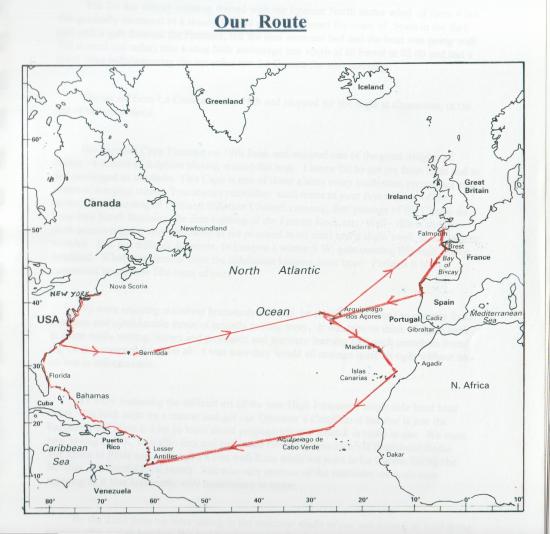
We took some very wise advice from the Piries. They suggested that, as we were not certain that we would enjoy a long ocean passage, we should start off earlier than the traditional time and sail down to north Spain and then cross to the Azores. This would give us a week or ten days of ocean sailing, with all that entails in practical and psychological terms, to find out if we would enjoy it. If, as they expected, we arrived full of enthusiasm then we would have an unhurried spell to fully explore and enjoy these beautiful islands. If we hated it, we could return to Cargreen pretending that this good cruise was our plan all along.
The islands are beautiful of the hedges of hydrangas and we explored most of them, and painted the traditional picture on the harbour wall in Horta, before sailing south to Madeira in August and eventually to Puerto Mogan on Gran Canaria from where we set off on the 27th November for our Atlantic crossing. Once we caught the trade wind, we bowled along under twin headsails most of the time. We caught some fish Glenn with a large one and me with a flying fish. Flying fish were good for breakfast and landed on deck most nights.
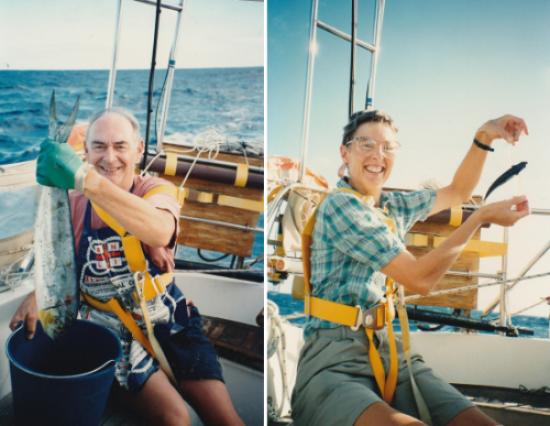
We made landfall in Barbados on 20th December to experience a joyous, and very different Christmas.
We sailed up the chain of islands of the Caribbean and the Bahamas finding some magical places including uninhabited Conception island in the south of the Bahama chain where this photo was taken.
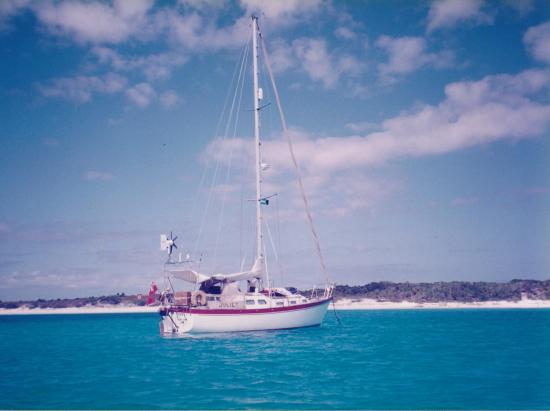
We entered American waters in Florida. Then we sailed the length of the Intra Coastal Waterway (ICW) that took us right up to Norfolk, Virginia. It was fascinating visiting so many different communities, and meeting welcoming locals and learning more of the history. We bypassed the Chesapeake Bay as it is crowded and humid and poor sailing winds in the summer, and sailed offshore to New York.
Sailing past the Statue of Liberty and into Manhattan was a great thrill.
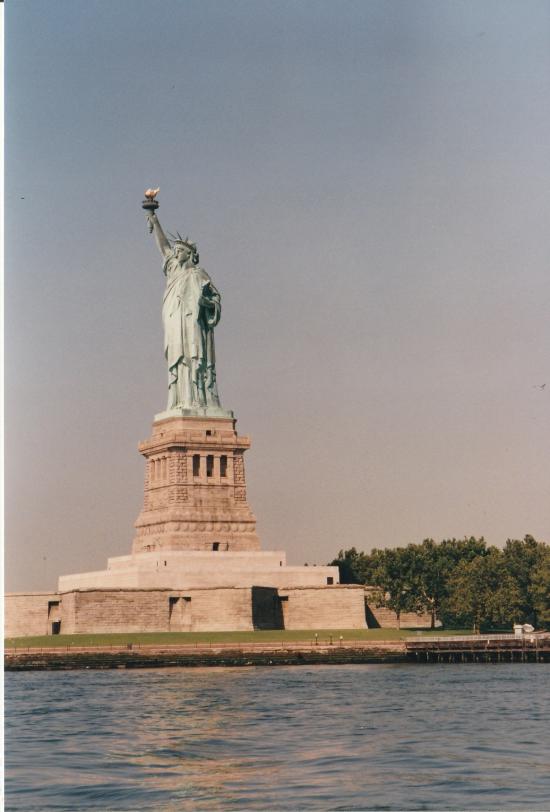
We sailed up to Cape Cod to have a reunion with some American friends, before returning south in the autumn to cruise the Chesapeake Bay with family.
We returned south in November to lay up “Juliet” in a North Carolina boatyard and made a short visit back to U.K to see my parents. We lived on board while we did winter work and had a short spell of unusually wintery weather. In February we took a short holiday, seeing a little of America, largely by rail.
On 1st May we set off for Bermuda, where we met up with a lot of the cruising boats we had got to know, and spent three weeks there. We then enjoyed seventeen days of interesting sailing to Flores which is the most westerly of the Azores group, where we spent 5 days. Then onwards the 30 miles to Horta and, after more boat socialising, back to Cargreen on 11th July.
It was exciting to see the CYC Club house, which had just been on a drawing board when we set off, and was now finished.
Glenn returned to the committee, and when in 1998 Commodore Dereck Hayter died suddenly half was through his tenure Glenn became Acting Commodore, before taking his two-year spell in office.
We continued to cruise as much as possible each season, mostly in Scotland and Brittainy, and in 1999 we sailed from Scotland through the Caledonian canal and then to Norway, Sweden and Finland, where we left the boat for the winter, and the following year in Finland joined up with a Millennium Rally of Cruising Association boats to sail to St. Petersburg. An amazing experience and loads of red tape to get through. When the rally dispersed, we continued our clockwise circumnavigation of the Baltic visiting all the states, mostly fairly newly released from Soviet rule and very welcoming to visitors. At the end of the season we laid up in a yard in Denmark, returning the following spring to sail home.
We spent much of the summer exploring the many delightful Danish islands and mastered the challenging art of mooring in a “Baltic box” when we were unable to anchor! We sailed home via the start of the Kiel Canal and then into the lovely Eider River and thence out into the North Sea and to Helgoland, then to Dutch waters at Nordeney. We then had the excitement of a new challenge as we took the “Riddle of the Sands” route through tidal watersheds of the drying sandbanks. Very careful calculations worked out and our echo sounder dropped to 0.3 meters under the keel.
As the weather off shore was rather unpleasant we decided to travel right through the Dutch canals to Ilissingen. We had cruised the southern canals several times before but the north was new. Back in Cargreen in mid July.
Our log books remind me that we kept cruising each season and in 2004 had a long cruise in Scotland. We loved it, and in 2008, having sailed there yet again, we decided to leave “Juliet” there for the winter to maximise the 2009 season, when we explored the Outer Hebrides.
We loved finding new places and new experiences and when there were few new places that we wanted to go, and the work of maintaining a boat was getting harder we decided it was time to stop and hand “Juliet” on to a new owner.
So, in 2013 we became ex mariners when we sold the boat to CYC member Nigel Coley. He loves her and is taking her on even more epic adventures.
© Margaret Honey, January 2026, All rights reserved
This article is protected by copyright - please contact editor@landulph.org.uk if you want to use it.