Water
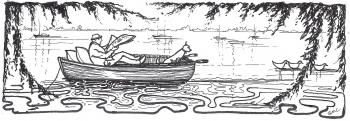
Fishing on Landulph Reach
'Above Saltash, Cargreen, a fisher town, showeth itself, but can hardly muster a mean plight of dwellings or dwellers; so may there care be green, because there wealth is withered . . .' (I believe that 'there' in this lame joke is an adverb, not the mis-spelling of 'their'.) Present-day residents should not be indignant, as there emerges, as you read more of this ‘Survey of Cornwall’, a reason for dismissing the village with such contempt, and for ignoring what must still have been a shipyard and working quay a short way downstream. The writer, Richard Carew, is a seventeenth-century son of the Carews of Antony House and is not about to rough it. So having apparently found no lavish host here, he moves quickly on to Halton, where he seems to have been generously entertained.
Although fishing must indeed have played a part in the diet and commerce of much earlier people on the Landulph shores and in the hinterland of the Tamar and Kingsmill lake, records are frustratingly hard to find. It’s again the seventeenth century that gives us more information on at least one of their methods: the fish weir. This simple and effective trap has been in use since the earliest times. Observed in primitive societies around the world and through the ages, in England remains have been discovered that date back to the Anglo-Saxons, and similar traps are still used on the Severn today.
These are not the barrier weirs like the one at Gunnislake, but a V-shape of stakes driven into the river bed, or of large stones, guiding the fish inside the V as they swim upstream and corralling them into a hollowed-out deep pool or a keep-net, so that at the turn of the tide, the fish remain trapped in there. At the Northern edge of the Landulph reach is the lowest of three salmon-traps, still just visible and in use until fairly recently: hollows dug into the river-bank, or at the widening of the mouth of a small creek. The bottom has been dug out and used to build a sill. As the tide ebbs, the salmon are trapped. Easy fishing: they caught themselves.
It turns out that we had a fish-weir here on Penyoke Lake. I’m indebted to Dr. Sharon Gedye, who has researched the Rivers Tamar and Tavy, for the following quotation, reproduced below in full . . .
'upon oath be the said George Nigles before us the 11th of July 1653. That the sd Court did the 6th of December 1640 contract with the peticon for a Grant to be made of him of ye sd fishing and of a certaine Old Weare within ye manor of Landolphe called Pinnocke Weir’.
This quote is from the following document_ KKME/Copy Order, 28th July 1653, removal of obstructions to weir and fishing of Calstock . . . to the Commissioners . . . from Colworth, alias Colworthy Hatch on the upper part to Toplingtor alias Tocklingtor’ (modern Okeltor) 'on the lower part.'
'From this point on, documents relating to the historic inland fishery of the Tamar, operated through to Calstock Weir, always seem to mention that the fishery also includes the fishing of the ancient weir of Penyoke . . . even though the weir has clearly ceased to exist for centuries, right up until 1893.'
Dr. Gedye further adds:
'Surrender of lease of Calstock Weir, made 1662 to Percy Edgcumbe, by Richard Edgcumbe 1685,' with the transcription by Peter Mayer in the Calstock Parish Archive, 'And also all that ancient and obsolete weir, called Penyocke Weare, within the Manor of Landulph in the said county – annual rent 4s.'
And another mention:
Copy of a draft lease of Calstock and other fisheries within the water of Tamar 27 Nov 1893 between HRH Prince of Wales and Devon Great Consols Co Ltd.:
'Also extends the rights along the river into the Manor of Landulph to waters known as Penniock Weir.'
Interesting conclusions from all this are that Calstock seems to have been the hub of fishing from Gunnislake to Landulph if not lower; that according to a couple of hints ('ALL that ancient and obsolete weir' and '4s rent') that we had quite a substantial structure and not, as I’d first imagined, a one-man set-up across the little creek by the playing-field. So where was it? Silt patterns have changed over the centuries and that could be why it became obsolete, but it’s tempting to speculate, however inaccurately, watching the fish swim upriver nowadays, on its location.
All the references to ‘fish’ made me look into the species that were prevalent then. First is the salmon, the King of Fish, the fish the Tamar and Tavy are famous for. This trade, once hugely respected, has disappeared. Very few if any salmon make their way up past Landulph now. A comment made by Herbie Braund many years ago was echoed by Alec Scoble in the 60’s and again by Alex Friendship more recently. All professional fishermen, they spoke regretfully of the falling stocks in the River. The cause is generally thought to be pollution. The Tamar has been seriously polluted since at least the second half of the C19 by copper and arsenic, later by agricultural run-off and raw sewage. This trend is increasing.
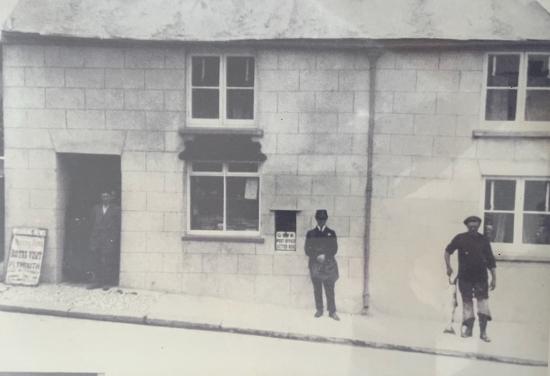
Mr, Herbert Braund with a salmon, outside the old Post Office, Fore Street, Cargreen.
While at Cotehele (upper limit of salmon fishing because of riverbed ownership) there were at least eleven Calstock boats, followed by Saltash, here at Landulph I have traced only the three generations of Braunds: Herbie, his son Bert and a grandfather, plus Cyril Channing, aided at times by Tony. As late as the fifties and early sixties, according to 'Maritime Life and Traditions' salmon were still driving up the River by the score, so what red-blooded fisherman could pass up the chance? This is where an article on the website can be the way to gather information valuable to Landulph. Names, anecdotes and photos can easily be added. I’m hoping that someone who knows more, not just about salmon-fishing but about anything in this article, will send it to the Editor@Landulph.org.uk. Be it an essay or a paragraph, it’s welcome.
Whatever the old boys say, salmon is not the only fish. One well-known fisherman on this reach was Alan Jewitt, of Saltash but based mainly on his boat below Weir Quay, who began fishing salmon with his father and brother, and moved on to eels. Known as the Eel-man, he lived and worked for many years on his distinctive boat brought down from the Norfolk Broads, the kind you can hire for a holiday. It suited him better, he said. When that one broke, he had another similar one brought down. His German Shepherd had learnt to navigate the outer deck, only a few inches wide. He eventually had a second identical dog which would pad equally nimbly around the boat. Allan fished for eel for many years, but found demand was falling, with competition from elsewhere. It was he who told me about many River quirks, such as the Eady tide, elsewhere called the eddy tide because that’s what it is; an eddy about a mile long at times, depending on the stage of the tide, stretching from about the Northern edge of the Landulph Reach almost to Halton. Useful to know, if you’re rowing or kayaking, that the River runs backwards in places.
The main activity was ‘tuck-net’ fishing. P.H.T.Hartley, B.Sc., in his 1940 survey ‘The Saltash Tuck-net Fishery and the Ecology of Some Estuarine Species’ gives a list of twenty-three and more different kinds of catch. Over the intervening twenty-six years, some have disappeared:
‘Flounder, dab,plaice, brill, sole, sand sole, herring, sprat, pilchard, sea trout, salmon, eel, pipe-fish, Jenyns, the smelt, risso,the grey mullets gadidae, dragonet, gobiidae, the pogge, the horse-mackerel, the bass, the mackerel and other species.’ I include them all for enjoyment of the names, because I bet that like me, you hadn’t heard of some of them and wouldn’t eat them unless starving. After all, have you missed pipe-fish and horse-mackerel? And I add two that Alex Friendship told me about: cucumber fish and stinky-fish. Saltash includes Landulph waters and a little way upstream you may find lampreys. (Beware of a surfeit).
Mr. Hartley continues: ‘ the inshore fisherman is confined by the small size of his boat to fishing-grounds of very limited extent . . . The mud flats which border the estuary of . . .the Tamar are the working grounds of a winter seine-net industry, carried on with open boats from villages along the shores. The net used is the Saltash tuck-seine, a modification of the ordinary shore-seine for use on very soft mud . . . The professional fishermen do not use the tuck-net in summer, for then salmon are a more profitable quarry than the flatfish and bass of the estuaries.’ The tucknet was cast from a small boat rowed in an elipse and the net itself had a wide mouth leading to a keep of a finer mesh.
I have detailed descriptions of how to fish with both a tuck- and a salmon-net and am happy to publish this here at some future date if it should prove to have mass appeal. Also to ask the University of Cambridge for permission to reproduce Mr. Hartley's findings in full.
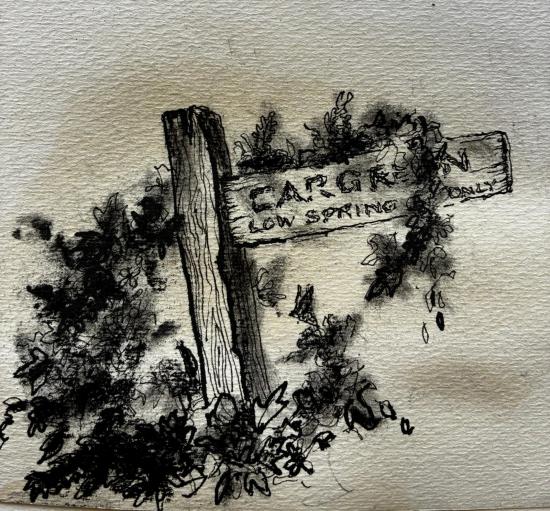
The fishing year began with oyster-dredging. Mr Hartley gives no details, but you can find oysters for yourself if you walk the shoreline path between Neal Point and Penyoke Lake. From the Point upstream for about 300 metres there’ll be empty shells, and stuck onto the rocks , occasionally at head-height, are a few live oysters. Bear in mind that the tidal range goes up to 5.2 m and that you will access the path only on one of the few very low Spring tides. These are non-native pacific oysters, ostensibly edible, and if you’re brave enough to eat them, be it on your own head and it’s currently illegal too. You may see the the Tamar designated a clean river but question the date of the report; the reality is described above. Bans are temporarily imposed from time to time because of e.coli. (And maybe check before wild swimming?)
Cockles were once gathered on Neal Point and at some ebb tides, you are walking more on cockle-shells than pebbles. Shellfish were once a useful source of protein, not just a sea-side treat. Just out of Landulph in Saltash, where Tamar Street now runs, was a ‘Picklecockle Alley’, where there was a small but thriving industry.
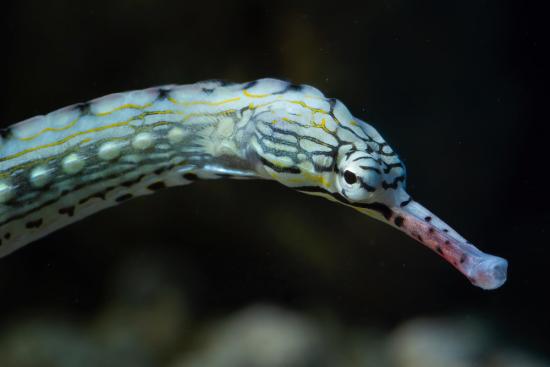
Pipefish. I chose him because I like sea-horses, and they're related.
I read that the prawn and shrimp season was midsummer, but as yet have no Landulph information, except that Ernest Talbot of Southwark, Cargreen, used to take a wide prawning net down to where Slipway Quay is now and catch shrimp. Mr. Talbot was not a professional; he was the taxi-driver and a market-gardener at the Coombe. One of the pictures of the past that have struck me most while researching this article is the of the resourceful residents. They sought and accepted a variety of employment, seemingly turning a hand with gusto to whatever there was. Times were hard; however, I’m pleased to claim acquaintance with people of that strong work ethic here now.
There's no commercial fishing here now. You sometimes see a solitary figure with a tripod and rod on the quay or at Neal Point. They're probably waiting patiently for bass, but according to Dominic Martyn of the Environment Agency who fishes here occasionally, they could find a variety; he has caught 'bass, eels, whiting, occasionally flounder and mackerel'. He has seen sea-trout and the occasional 'salmon splash'. The Jermain family of 'Tamarisk', Lower Fore Street, have eaten whiting caught by Dom and have found them delicious. Whiting caught from the Quay have also been cooked by a well-known chef staying in the 'Boat House'. I heard no more of that. Dominic's list of species doesn't include the heaps of grey mullet writhing at the surface by the Spaniards quay and the corner of Sammy Sam's. Maybe they're transients.
As for the small day-boats often seen lurking at the confluence of the Tamar, Navy and Kingsmill Lake, it can't be the prized bass they're waiting for, as they can only be fished from the shore.
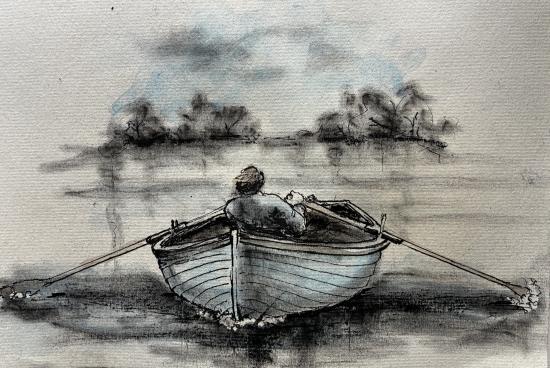
This overview ends with a piece from Angela Copeland, of the Lanyon salmon-fishing family. I asked her for anecdotes of her dad’s fishing days, expecting a few funny stories or technical boat information. Instead, she wrote . . .‘The stillness of the river as the fisherman scans the river, waiting for a fish to jump before rowing out and launching the net in the hope that the salmon will swim right in. The knock of the paddles on the tholepins as he rows an arc back to the shore. The look of joy on the fisherman’s face as he sees the silvery salmon in the net as he pulls it ashore and the thoughtful expression on his face as he guesses the weight. To be involved in the fishing or just being a bystander, these are special moments.’
© Gill Mannings Cox, November 2025, All rights reserved
With grateful thanks to:
P.H.T. Hartley, B. Sc.
Dr. Sharon Gedye
Mr N. Cummings
Mr. Richard Hosking
Mr. Andrew Barrett
Mrs. Angela Copeland
This article is protected by copyright - please contact editor@landulph.org.uk if you want to use it.